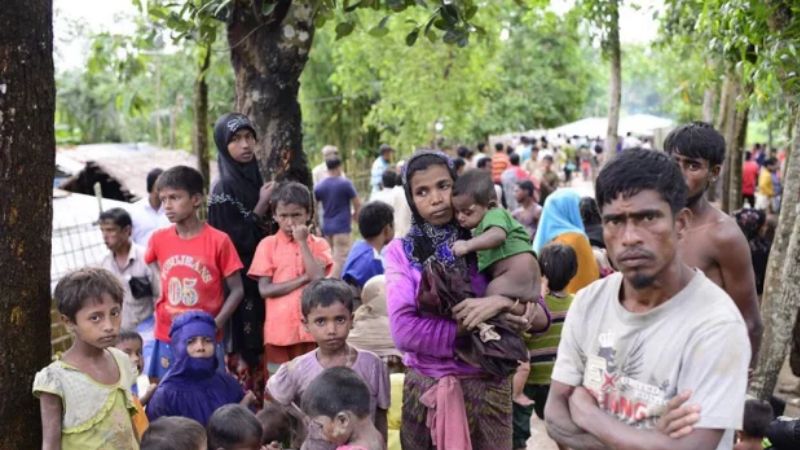
A sweeping police crackdown in the Shaheen Bagh Rohingya settlement has sent shockwaves through the refugee community, as law enforcement officials forcibly rounded up Rohingya refugees without explanation. What initially appeared to be a bureaucratic biometric verification exercise has unfolded as a full-scale campaign of intimidation and dehumanization.
Rohingya refugees in the settlement reported being subjected to racial slurs, physical coercion, and threats of deportation. Officers forcefully escorted individuals to police stations for biometric verification without providing any legal explanation. The pattern of enforcement extended beyond Shaheen Bagh, with distress calls from multiple settlements across Delhi indicating an indiscriminate targeting of the Rohingya community.
Eyewitnesses and victims recounted how police personnel intimidated refugees into compliance, forcing them to sign documents in languages they did not understand. Many were taken to undisclosed locations without legal representation. These actions blatantly disregard multiple constitutional protections, including Article 21, which guarantees the right to life and personal liberty for all individuals, irrespective of nationality, and Article 14, which ensures equality before the law.
Further compounding these violations, the Bharatiya Nagarik Suraksha Sanhita (BNSS), 2023, explicitly prohibits detentions or summons without a written notice—yet police officials flouted this provision. Additionally, the Supreme Court’s landmark ruling in Puttaswamy (2017) reinforced the right to privacy by prohibiting unauthorized biometric data collection. The police’s actions in forcibly collecting refugees' biometric data without due process violate both national and international human rights laws.
The crackdown did not conclude with a single round of biometric registration. Reports from across Delhi indicate that Rohingya families continue to face relentless police harassment. Police stations repeatedly summon refugees under vague pretexts, detaining them arbitrarily. The situation has escalated to economic marginalization, as landlords, fearing legal repercussions, have begun evicting Rohingya tenants, pushing many into homelessness in Kanchan Kunj.
A Rohingya refugee expressed his despair: “We fled Myanmar to escape persecution, to avoid being treated as criminals simply for existing. Yet here, in what we hoped would be a refuge, we find ourselves once again under suspicion, under scrutiny—living in a shadow of uncertainty.”
Human rights advocate Ujjaini strongly criticized the state’s handling of the issue. “The manner in which these processes are being conducted is entirely inconsistent with the rule of law. Instead, they reflect humiliation and dehumanization. The police urgently require training and sensitization to interact with migrant communities, as they fail to distinguish between an ‘illegal migrant’ under the Foreigners Act, 1946, and a refugee as defined by the Standard Operating Procedure (SOP) issued by the Union in 2019.”
A lawyer, speaking anonymously, added, “The Rohingyas in India are already in an extremely precarious situation. Instead of offering legal pathways to protection, authorities are subjecting them to unpredictable and coercive measures that intensify their vulnerability.”
Despite the annual biometric data collection, authorities have failed to assess Rohingya refugees in accordance with the SOP. The Foreigners Regional Registration Office (FRRO) is required to recommend a claim to the Ministry of Home Affairs for a Long-Term Visa (LTV) within thirty days, considering the conditions in the refugees’ home country. However, the government has neglected this crucial step.
A social worker assisting displaced Rohingya families highlighted the increased vulnerability of women and children. “We are seeing a growing number of cases where young girls and women are particularly at risk of human trafficking. Without legal protection, they become easy targets for exploitation.”
The crackdown violates not only domestic legal standards but also India’s international obligations under the Universal Declaration of Human Rights and customary international refugee law. Instead of adhering to established legal protocols, authorities have resorted to forceful and arbitrary actions that expose refugees to further abuse.
In Madanpur Khadar, Rohingya refugees live in deplorable conditions, without access to basic amenities, despite a Supreme Court directive from May 11, 2018, mandating the Sub-Divisional Magistrate (SDM) to ensure their well-being. The SDM’s failure to act constitutes a serious dereliction of duty. A devastating fire in June 2021 left 53 Rohingya families homeless, yet no substantial rehabilitation measures have been undertaken, forcing residents into makeshift shelters that lack sanitation and clean drinking water.
Further exacerbating their plight, 17 families who secured rented accommodations in Kanchan Kunj are now being arbitrarily pressured by police to vacate their homes and return to hazardous settlements. Civil society organizations and activists have intervened to relocate some families, but the ongoing police intimidation undermines these efforts.
The crackdown on Rohingya refugees has exposed a systemic pattern of forced evictions, economic marginalization, and arbitrary detentions. The absence of accountability has emboldened law enforcement to act with impunity, leaving the community in a perpetual state of fear and vulnerability.
If India is to uphold its constitutional and international obligations, immediate steps must be taken to cease the harassment of Rohingya refugees, implement a transparent legal framework for verification procedures, and hold those responsible for rights violations accountable. The targeted crackdown reflects a deeply troubling erosion of legal protections for one of the world’s most vulnerable communities.
BOB Post