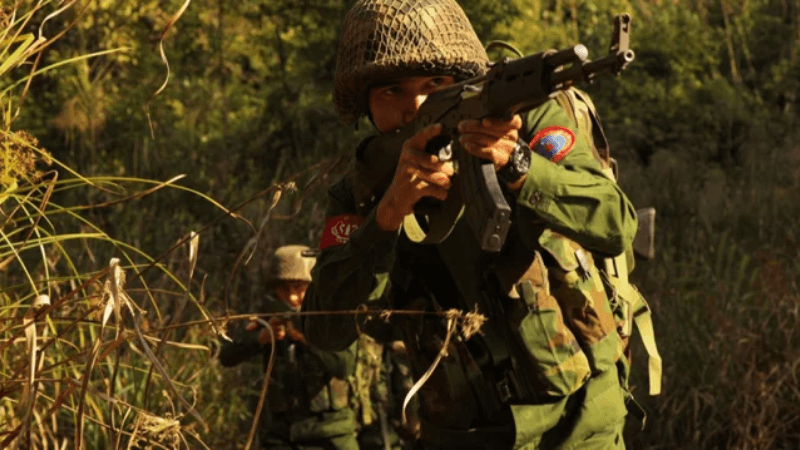
In a disturbing escalation of the crisis in northern Rakhine, the Arakan Army (AA) has forcibly expelled Rohingya families from multiple villages in Maungdaw Township, according to testimonies from residents and local monitors. The armed group is reportedly dismantling abandoned Rohingya homes and using the stolen building materials — including timber, planks, and corrugated metal — to construct military outposts and fortified camps.
Villages such as Myo Taung, Ngan Chaung, and Gone Nar have seen near-total depopulation of their Rohingya communities over recent weeks. Witnesses say AA fighters not only drove out residents but also stripped homes of usable materials and seized farmlands, fisheries, and water sources — many of which were then reportedly handed over to ethnic Rakhine civilians aligned with the armed group.

“More than 100 households have been expelled from Myo Taung alone,” said a resident who fled to the Bangladesh border region. “Their homes were dismantled, their lands confiscated, and everything of value taken. Some of these lands have been redistributed to Rakhine families under AA control.”
In what observers call a systematic campaign of ethnic cleansing, the AA’s actions appear to mimic tactics historically used by Myanmar’s military — the very force the AA claims to oppose. Human rights monitors now warn that the armed group’s growing footprint in northern Rakhine may herald a new wave of oppression for the already-persecuted Rohingya minority.
According to multiple local sources, the AA has also been accused of forcing remaining Rohingya men to work under duress — building fences, carrying timber, or assisting in the construction of AA bases. Others are made to hand over food and harvests, often without any compensation.
“They are harvesting our vegetables and crops without asking, leaving us with nothing,” said one farmer from Gone Nar. “If we protest, we are threatened or beaten. Some have disappeared.”

These claims are supported by satellite imagery and on-the-ground photos reviewed by rights groups, which show new military-style fortifications erected near recently evacuated Rohingya villages.
For many Rohingya, the recent AA abuses mark yet another chapter in a long history of persecution. Over the past decade, hundreds of thousands have fled state-backed violence, including the 2017 military campaign labeled a genocide by the UN. Now, some fear the AA is replacing the junta as the new face of oppression.
“Even though the Rohingya escaped the brutal rule of the military regime, they are now under the control of another armed group — the Arakan Army,” said a human rights monitor based in the region. “This group is limiting their movement, seizing their property, and subjecting them to coercion and abuse. It is unlawful and morally indefensible.”
Despite the grave nature of these violations, international attention remains focused on the broader conflict between the AA and the Myanmar junta. Analysts warn that without urgent intervention, the plight of the Rohingya in AA-controlled areas will be ignored — and their suffering prolonged.
“AA’s growing control of northern Rakhine does not mean safety for the Rohingya,” said a representative from a regional watchdog. “On the contrary, it risks entrenching a new regime of exclusion and exploitation — one that mirrors the same brutal practices the AA claims to oppose.”
Displaced families are calling for international observers, humanitarian access, and concrete guarantees of safety and property rights. Yet with conflict deepening and both sides continuing to violate human rights, the future for Rohingya communities in northern Maungdaw looks increasingly bleak.
“Our homes have become army posts. Our land is no longer ours,” said a displaced villager from Gone Nar. “We have no say, no rights, and nowhere to go. We are being erased, again.”
BOB Post