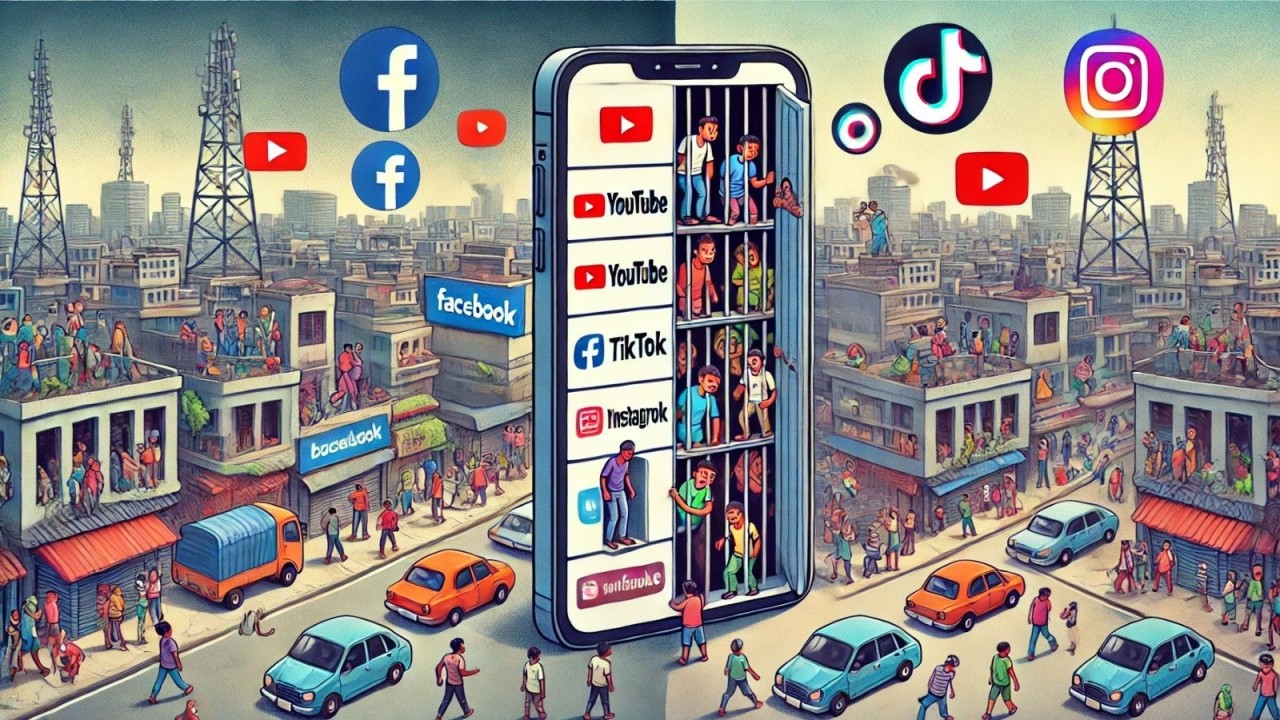
The next big development challenge in South Asia may not be found in a classroom, factory, or office. It may be sitting in the palm of a young person’s hand.
A smartphone can deliver a university lecture, a job opportunity, or breaking news in seconds. It can also keep a person locked into an endless stream of short videos, notifications, and algorithm-driven entertainment.
That tension is becoming a serious policy question.
Singapore has now launched a five-year national campaign to rebuild reading habits. Its approach is strikingly simple. People can log reading sessions online, earn virtual points and receive small cash rewards for sustained participation.
The payment is tiny. The policy idea is much bigger. For South Asia, where hundreds of millions of young people are growing up with smartphones and social media, governments may need to think beyond digital connectivity. They also need to think about what people do with their attention once they are connected.
The concern is not that every hour spent online is harmful. Digital platforms are now important tools for education, communication, business and employment. The problem is the growing competition for attention.
Short-form content is designed to keep users moving from one piece of content to another. Over time, this can make sustained attention harder. The popular term “brain rot” captures this anxiety, although it is not a medical diagnosis.
Research offers a more concrete warning. The World Health Organization has reported rising levels of problematic social media use among adolescents. In its survey across 44 countries and regions, 11% of adolescents showed signs of problematic social media behavior.
The region has one of the world's largest youth populations. Its future economic strength will depend heavily on whether this generation can learn, adapt, and produce new ideas.
That makes reading more than a cultural activity. It is part of human-capital development.
A worker who can concentrate on a long report, understand complicated information, and distinguish evidence from misinformation has an advantage in almost every modern profession. The same skills matter for engineers, journalists, entrepreneurs, civil servants, researchers, and business leaders.
The economic argument is therefore difficult to ignore.
South Asian governments are investing billions in roads, ports, power plants, digital networks, artificial intelligence, and industrial capacity. But physical and digital infrastructure cannot deliver their full value without people capable of using them productively.
Attention is also infrastructure.
The region's education systems make the issue even more urgent. Learning losses and weak foundational skills remain major concerns. The World Bank has estimated that 78% of 10-year-olds in South Asia could not read and understand a simple text after the pandemic-era disruption.
At the same time, internet access is expanding rapidly.
This creates a new policy paradox: South Asia must close the digital divide without allowing digital consumption to become a substitute for learning.
A national reading strategy could help address both sides.
Schools could introduce protected daily reading time. Public libraries could be modernised as community learning centres. Universities could create reading and discussion programmes. Governments could support book clubs, local-language publishing and reading challenges.
Singapore's experiment also raises another possibility: using the same gamification techniques that make digital platforms addictive to encourage healthier habits.
The objective, however, should not be to pay people forever to read. The reward should be a starting mechanism, not the destination.
The real success would come when a teenager reads because curiosity has become stronger than the urge to scroll.
That will require more than government campaigns. Parents, schools, publishers, technology companies, universities and civil-society organisations all have a role.
South Asia does not need a war against smartphones. It needs a better balance between the screen and the page.
The region's greatest resource is its young population. But a large young population becomes an economic advantage only when it is educated, creative and capable of sustained thinking.
The competition ahead is not simply for jobs or investment. It is a competition for human attention and the countries that learn how to protect, educate and productively direct that attention will shape the minds that build South Asia's next economy.
BOB Post