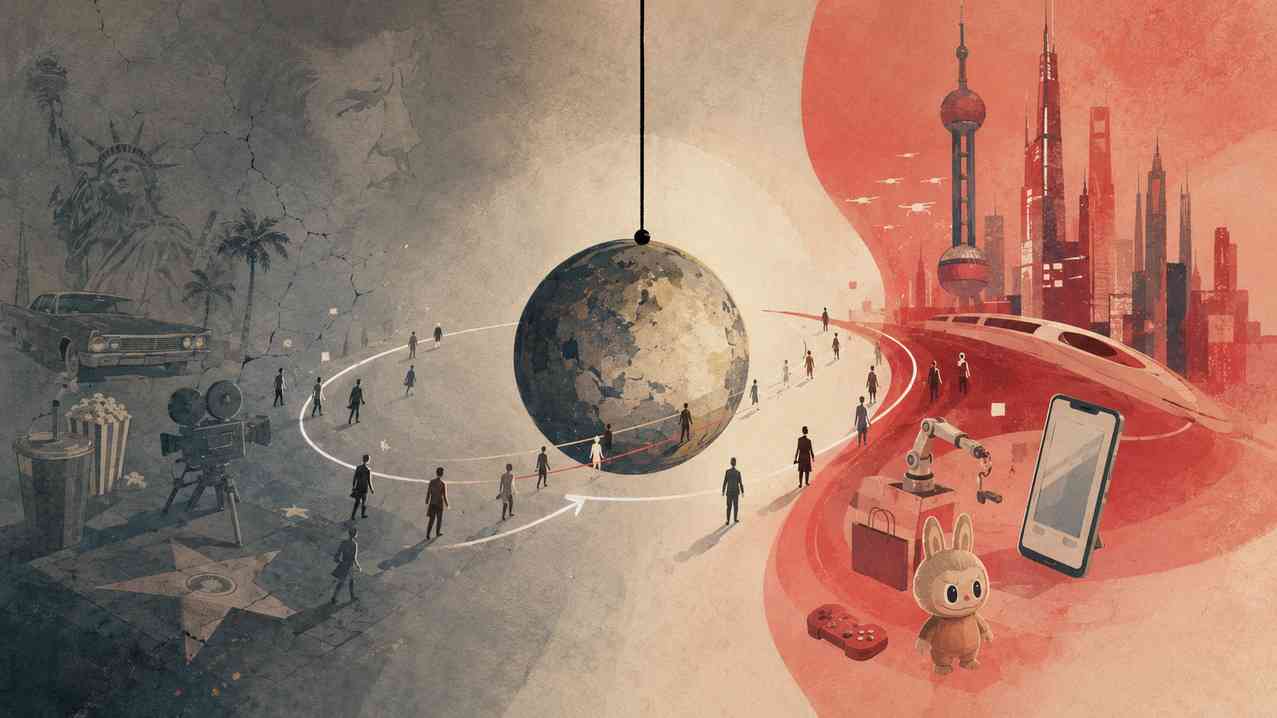
Soft power rarely arrives with a flag. It slips into daily life almost unnoticed -in the car parked outside, the phone in your hand, the solar panel on a rooftop or the train carrying commuters across a city. That is where China’s influence is quietly expanding, while America is discovering that global admiration, once taken for granted, can also be lost.
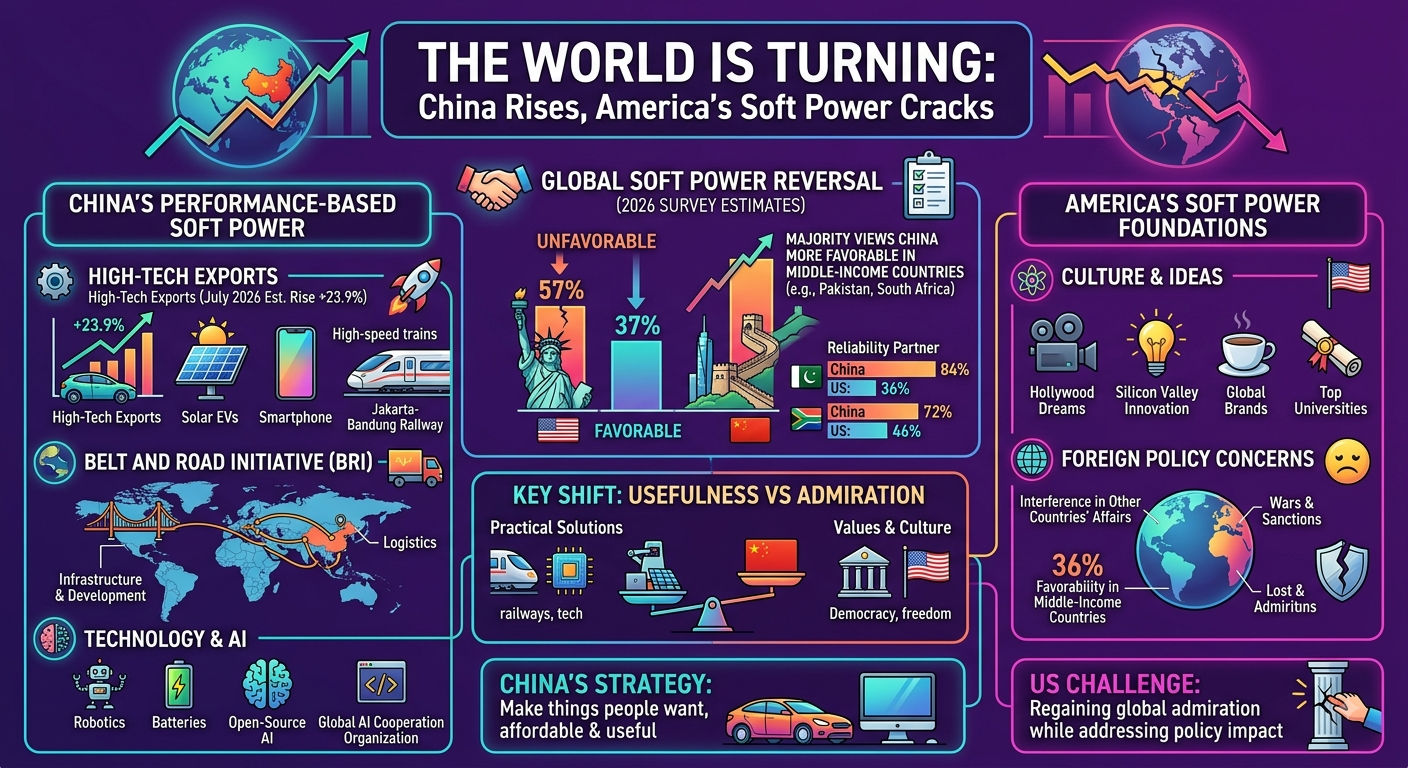
A new survey by the Pew Research Center offers an important clue. In its 2026 study of 42,151 people across 36 countries, China was viewed more favorably than the United States in most of the countries surveyed. It is the first time Pew has recorded such a reversal.
The result does not mean China has suddenly become universally popular. It has not. Views of China remain substantially more negative in many wealthy democracies. Nor does it mean America has lost all of its appeal. But the direction of travel is difficult to ignore: China’s image is improving while America’s is weakening.
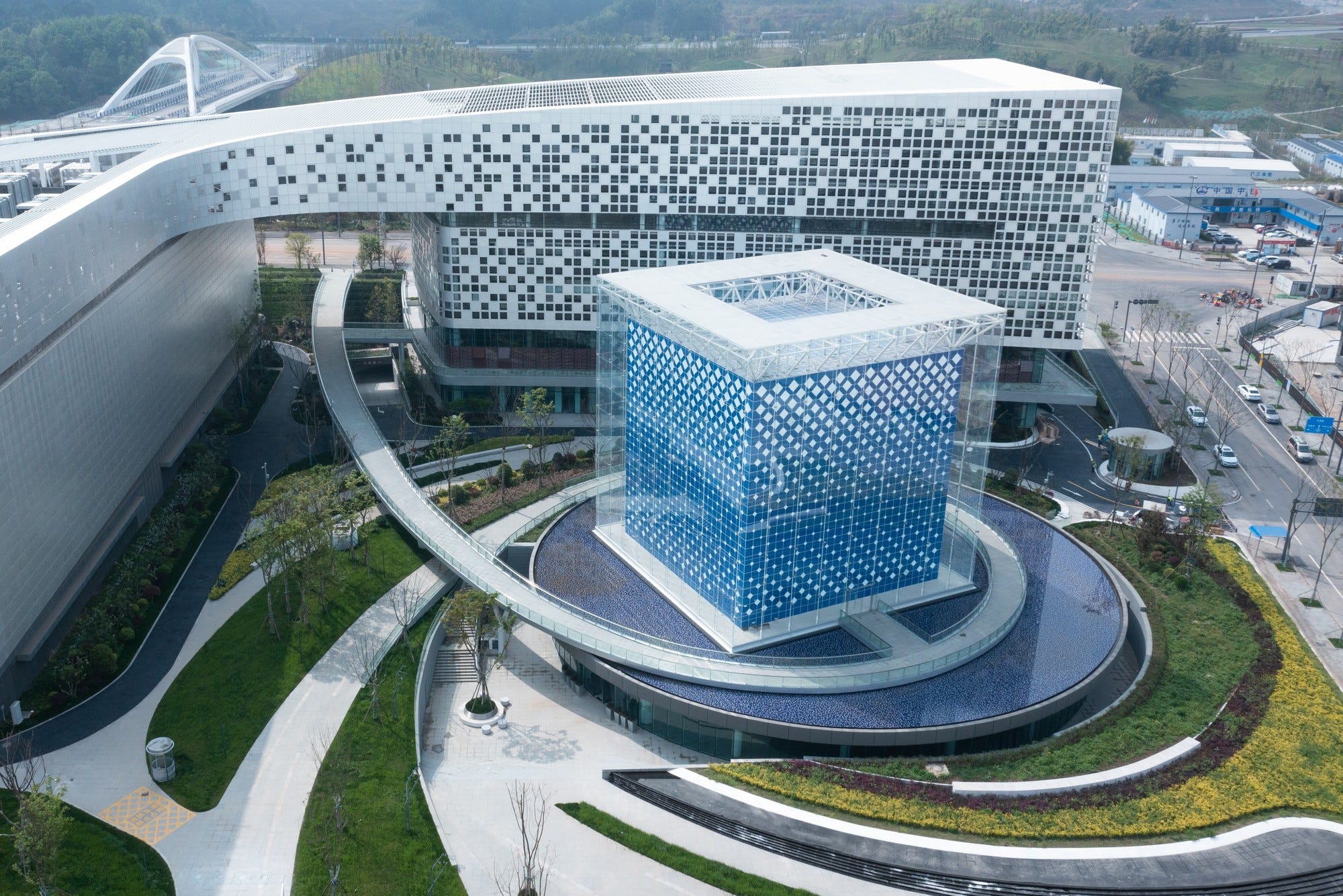
This is where the idea of soft power becomes useful.
Harvard political scientist Joseph Nye coined the term in the late 1980s and developed it in Bound to Lead: The Changing Nature of American Power. His central argument was simple: countries can influence others not only through military or economic pressure, but by making their culture, values and policies attractive.
For much of the post-Cold War era, the United States was the master of this game. American universities attracted the world’s brightest students. Hollywood exported dreams. Silicon Valley exported technology. American music, brands and popular culture travelled almost everywhere.
China is now building a different kind of attraction.
It is increasingly based on performance.
Look at the global spread of Chinese electric vehicles. A consumer does not need to admire Beijing to buy a Chinese car. The calculation can be much more ordinary: price, design, range, technology and running costs.
The same logic applies to solar panels, batteries, smartphones, high-speed rail and industrial machinery. China’s manufacturing strength is increasingly visible in the products people use rather than simply in government speeches.
The transformation is particularly striking in technology.
Chinese companies are no longer competing only in low-cost manufacturing. They are pushing into electric mobility, robotics, batteries and artificial intelligence. Reuters reported that China’s exports rose 23.9 percent year-on-year in July 2026, with strong demand for high-tech goods and AI-related products helping drive the increase.
AI may become an even bigger part of this story.
At the World Artificial Intelligence Conference in Shanghai in July, Chinese President Xi Jinping presented open-source AI as a way to widen access to advanced technology, particularly for developing countries. Twenty-nine countries also signed an agreement to establish a global AI cooperation organization.
Whether China ultimately dominates AI is still an open question. But the political message is already clear. Beijing wants its technological rise to be associated with accessibility and development, not simply commercial competition.
That matters in the Global South.
For many developing countries, the question is not which superpower has the more attractive political system. It is often much more practical: Who can build the railway? Who can finance the port? Who can supply affordable technology? Who can help build an industrial base?
This is one reason China’s Belt and Road Initiative has become an important part of its international image.
The Jakarta-Bandung high-speed railway in Indonesia is a useful example. It turned a Chinese-backed infrastructure project into something passengers could actually experience. Across Africa, Asia and Latin America, Chinese-built infrastructure has similarly made Beijing’s presence tangible.
The United States has powerful answers of its own. Its universities, technology companies, entertainment industry, financial system and civil society remain major sources of attraction. China also faces serious questions over political freedoms, transparency, debt, governance and the conditions attached to some overseas projects.
But soft power is not a beauty contest with a permanent winner.
It changes when people’s priorities change.
And there is another side to the current shift: America’s own foreign-policy choices have damaged some of the foundations of its appeal.
Pew’s 2026 research found that only 37 percent of respondents across the 36 countries surveyed held a favorable view of the United States, while 57 percent held an unfavorable view. In 16 of 17 middle-income countries surveyed, majorities said the US interferes substantially in the affairs of other countries.
That is a serious warning for Washington.
Soft power cannot be manufactured by public-relations campaigns. A country can advertise democracy, freedom and international leadership. But people also judge what they see.
Wars matter. Sanctions matter. Foreign-policy consistency matters. So does whether a country is perceived as listening to smaller states or simply telling them what to do.
This does not automatically make China the new moral leader of the world. It does, however, create space for Beijing.
Pew’s findings show that the shift is especially visible outside the traditional Western sphere. In Pakistan, for example, 84 percent of respondents described China as a reliable partner, compared with 36 percent for the United States. In South Africa, 72 percent viewed China as a reliable partner, against 46 percent for the US.
These numbers reveal something larger than a popularity contest.
For much of the developing world, power is increasingly judged by usefulness.
The country that helps build a road, lowers the cost of a vehicle, supplies affordable technology or expands access to energy may acquire a form of influence that no embassy can manufacture.
That may ultimately be China’s most important soft-power advantage.
Joseph Nye argued that the strongest form of influence is the ability to make others want what you want. China may now be discovering another route: make something people want, make it affordable, and let everyday experience do the diplomacy.
The next chapter of the US-China rivalry may therefore be fought less in conference rooms and more in ordinary places on highways, at ports, in factories, on smartphones and inside computer screens.
The most powerful ambassador, after all, may not be a diplomat. It may simply be something people find useful.
BOB Post